
The Department of Art + Art History and The Center for the Study of Ideas and Practices at the University of North Carolina at Charlotte, in co-sponsorship with The Center for Advanced Studies – Erlangen, The University of Exeter’s Centre for Magic and Esotericism, and Societas Magica will host Creative Practices and Bridging the Invisible, to be held online from October 15th-17th, 2026. The conference will occur in tandem with the art exhibition Holding a Bright, Untroubled Sky: Visioning a Better World through Magic held in the Rowe Galleries at the University of North Carolina at Charlotte and curated by Dr. Amy Hale.
The Center for the Study of Ideas and Practices is a multidisciplinary hub dedicated to the scholarly exploration of magic, esoteric, and religious traditions and knowledge systems across global and historical contexts. For more information, see: https://magic.charlotte.edu/
WhiteFeather will present her work as part of the panel, Architecture of the Invisible and Invisible Architecture, convened by Andrea Franchetto.
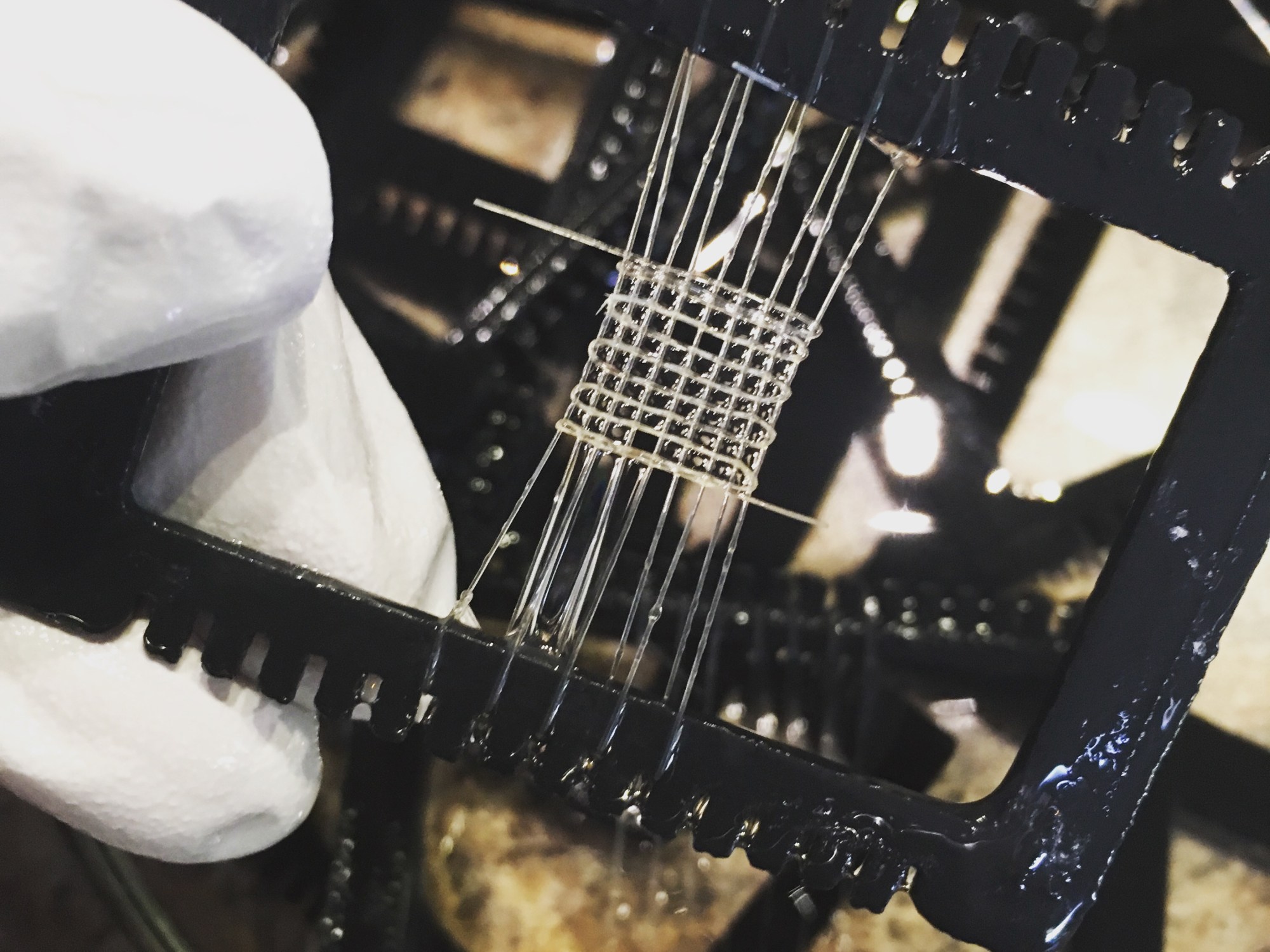
Internal Architectures: Handwoven Scaffolds and the Autopoiesis of Living Matter by WhiteFeather Hunter.
This presentation examines handwoven tissue-engineering scaffolds as forms of internal architecture: miniature spatial systems designed to host and guide the invisible processes of cellular life. Situated at the intersection of feminist biofabrication, craft epistemologies, and tissue engineering, the work frames scaffolds as active architectural propositions that foster cellular autopoiesis: the capacity of living matter to self-organize, repair, and sustain itself. Beyond biomedical function, these woven structures engage the mythic history of weaving as a technology of directing ‘fate’. Across many cultures, weaving has operated as a cosmological practice in which time, continuity, and relational order are constructed through the tension of manipulated threads. Rather than strictly determining outcomes, such practices shape the conditions of becoming. In my work, I extend this lineage to the interior of the body, where fibre, void, and vital force shape environments that allow living systems to emerge in designed relation to one another. In contrast to industrial biomaterials optimized for uniformity and scalability, handwoven scaffolds rely on haptic tension, or tension sensed and negotiated through embodied making. This haptic intelligence produces architectures of carefully calibrated porosity and material resistance that influence cell adhesion, migration, and differentiation. The scaffold thus functions as an invisible architecture of ‘fate’: a responsive framework that guides autopoietic processes while allowing cells to co-author their own structural futures. By situating tissue engineering within architectural, mythic, and material histories of weaving, this talk reframes biofabrication as a contemporary site where architecture operates endogenously, shaping invisible worlds within living matter.
 whitefeatherhunter.net